
Astronomical Spring Arrives: Understanding the Vernal Equinox
After months of winter weather, signs of spring are emerging across many regions. Flowers begin to bloom, trees show new growth, and daylight hours steadily increase following the recent time change. The astronomical beginning of spring in the Northern Hemisphere approaches with the arrival of the vernal equinox.
While these seasonal transitions may receive less attention than solstices, equinoxes provide meaningful opportunities to observe nature’s cyclical changes. Understanding what causes the spring equinox and its significance offers insight into our planet’s relationship with the sun.
Understanding the Spring Equinox
As winter concludes, many people notice the gradual extension of daylight hours, particularly after recent clock adjustments. The spring equinox represents the pivotal moment when days begin to outlast nights significantly.
The term “equinox” derives from Latin words meaning “equal” and “night,” reflecting how daylight and darkness achieve approximate balance during this period. Two equinoxes occur annually: the spring version and its autumn counterpart. “Vernal” originates from Latin terminology associated with springtime.
Earth rotates on an axis running between its poles, tilted at 23.5 degrees. This inclination causes different planetary regions to receive varying amounts of direct solar radiation, creating seasonal patterns. This mechanism explains why Northern Hemisphere summer coincides with Southern Hemisphere winter.
According to Emily Rice, an astrophysics professor at Macaulay Honors College of the City University of New York, the spring equinox occurs when the Northern Hemisphere shifts from pointing away from the sun during winter to angling toward it for summer. During this brief moment, Earth’s tilt aligns with its orbital path, producing nearly identical periods of daylight and darkness.
Timing of the Vernal Equinox
The spring equinox occurs at a precise moment: 10:46 a.m. Eastern Time or 7:46 a.m. Pacific Time on Friday, March 20.
Distinguishing Equinoxes from Solstices
Solstices represent the extreme points of seasonal daylight variation. Summer solstice brings the year’s longest day, while winter solstice delivers the shortest. For 2026, the Northern Hemisphere’s summer solstice falls on June 21, with the winter solstice occurring on December 21.
Solstices tend to receive greater public recognition than equinoxes. Rice explains that extreme conditions are easier to recognize and understand compared to transitional moments, which involve more subtle changes. Both phenomena result from Earth’s axial tilt and solar relationship, making them related seasonal markers with distinct characteristics.
Observing Earth from Space During Equinox
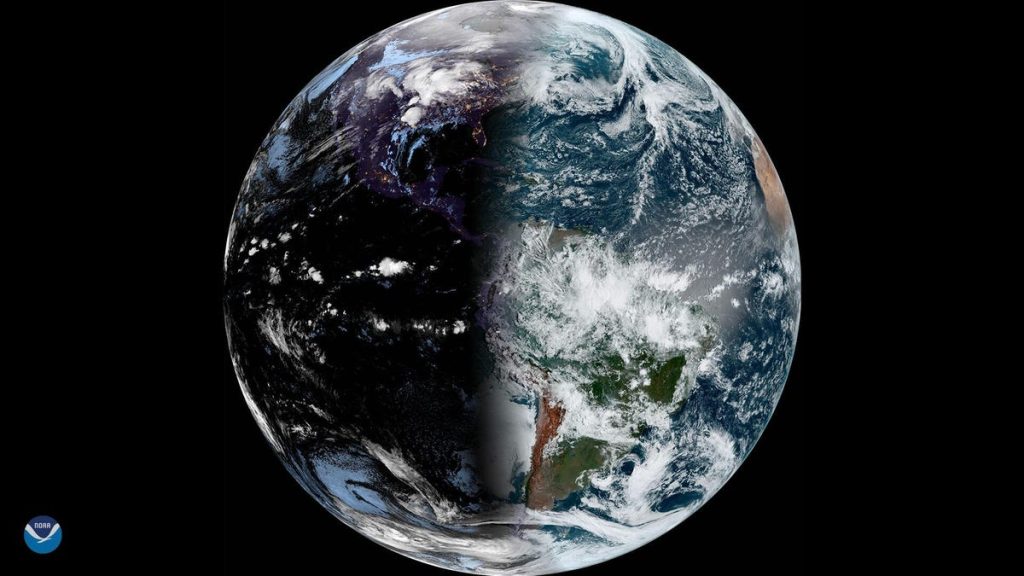
Visualizing Earth’s tilt and equinox mechanics from ground level can be difficult. NASA created satellite footage showing our planet throughout its seasonal cycle, demonstrating how light and shadow patterns shift over time.
Marking the Spring Equinox
A persistent myth claims that raw eggs can only be balanced upright during equinox days, supposedly due to gravitational forces and celestial alignment. However, this belief lacks scientific foundation.
Rice regularly addresses this misconception, noting that astronomers frequently debunk the egg-balancing legend online. While people can attempt this feat on the equinox, they should also try it on other dates to test the theory’s validity.
The equinox represents a subtle astronomical event without dramatic celestial displays. Nevertheless, this shouldn’t diminish its significance. The spring equinox holds whatever meaning individuals choose to assign it.
Rice observes that since Earth’s orbit lacks clear beginning or ending points, any date could theoretically start a new year, making the equinox more astronomically relevant than January 1st.
People can create personal traditions to honor this occasion: announcing astronomical spring’s arrival, starting garden projects, organizing living spaces, enjoying outdoor activities, or planning seasonal getaways. Taking time to appreciate the sun, Earth’s tilt, and our cosmic position that enables the vernal equinox provides a meaningful way to mark this transition.